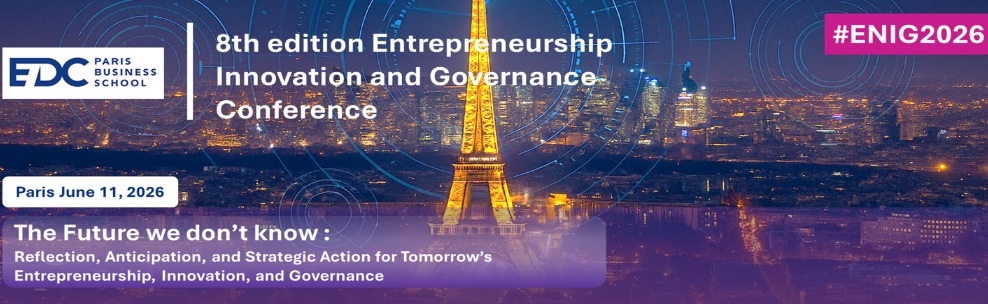
Appel à communicationAppel à CommunicationL’avenir de l’entrepreneuriat, de l’innovation et de la gouvernance est marqué par une incertitude croissante liée aux crises climatiques, géopolitiques, sanitaires, numériques et sociétales. Ces polycrises rendent les approches traditionnelles insuffisantes et exigent de nouvelles capacités d’anticipation, de collaboration et d’action stratégique. La conférence ENIG 2026 réunira chercheurs, entrepreneurs, décideurs et praticiens pour explorer comment réinventer l’entrepreneuriat, l’innovation et la gouvernance dans ce contexte. Elle s’intéressera au rôle des écosystèmes entrepreneuriaux en tant que leviers de résilience, aux opportunités et aux enjeux éthiques liés à l’IA, et à la transition vers des modèles de création de valeur intégrant durabilité, responsabilité et inclusion. Sur le plan organisationnel, les futurs inconnus appellent des formes de gouvernance fondées sur l’agilité adaptative, l’inclusion, la conscience climatique et la prise de décision augmentée par l’IA. Les contributions attendues pourront éclairer sur la manière dont ces capacités transforment les organisations et leurs pratiques. Les entreprises, confrontées à des défis systémiques complexes et interconnectés, doivent repenser leurs stratégies, leurs mécanismes de coopération et leurs modèles de création de valeur. Les technologies numériques, les plateformes et les données ouvrent de nouvelles possibilités, tout en soulignant des exigences accrues de transparence et de responsabilité. Enfin, les comportements des consommateurs évoluent sous l’effet de la numérisation et de l’IA. Les enjeux de personnalisation, d’éthique, d’inclusion et de durabilité deviennent centraux, transformant profondément les pratiques marketing et les attentes sociétales. Nous vous invitons à soumettre des propositions de communication pour la conférence ENIG 2026. Les contributions pourront adopter des approches variées — théoriques, empiriques, fondées sur des études de cas ou interdisciplinaires — et devront s’inscrire dans le thème général de l’édition 2026. Cependant, plusieurs sessions thématiques sont consacrées à différents processus d'affaires liés à la stratégie, à l'entrepreneuriat, à la gouvernance et au marketing. Vous pouvez soumettre une communication à la session plénière ou à une session thématique.Thématiques speciales: Merci de consulter l'anglet THEMATIQUES. Track 1: Ecosystème entrepreneurial et innovation responsable et sociale Track 2: Construire l'entrepreneuriat de demain : apprendre à s'adapter, anticiper et innover Track 5 : Organisations à impact face à l’incertitude : gouvernance, mesure et stratégies d’action Track 6 : Repenser l'extrême : vers de nouvelles approches de gestion ? Track 8 : Entreprises familiales : naviguer les paradoxes de la transformation contemporaine Track 9 : Au-delà de l’ESG : la finance régénérative nouveau paradigme d’investissement Track 11 : Lien entre entrepreneuriat, finance et macroéconomie : marchés et politiques publiques Track 12 : L'innovation pédagogique de demain: les étudiants que nous ne connaissons pas References Adomako, S., Gyensare, M. A., Amankwah-Amoah, J., Akhtar, P., & Hussain, N. (2024). Tackling grand societal challenges: Understanding when and how reverse engineering fosters frugal product innovation in an emerging market. Journal of Product Innovation Management, 41(2), 211–235. Aguilera, R. V., & Ruiz Castillo, M. (2025). Toward an updated corporate governance framework: Fundamentals, disruptions, and future research. Corporate Governance: An International Review, 33(2), 156-178. Ajith, M. M., Lux, A. A., Bentley, T., & Striepe, M. (2024). Adaptive crisis management at the operational level: Responses to COVID-19 in the Australian resources sector. Journal of Management & Organization, 1-25. doi:10.1017/jmo.2024.62 Ameen, N., Tarba, S., Cheah, J., Xia, S., & Sharma, G. D. (2024). Coupling Artificial Intelligence capability and strategic agility for enhanced product and service creativity. British Journal of Management, 35(4), 1486-1508. doi:10.1111/1467-8551.12797 Anastasiou, D., Ballis, A., Guizani, A., Kallandranis, C., & Lakhal, F. (2024). Monetary policy impact on sustainability: Analyzing interest rates and corporate carbon emissions. Journal of Environmental Management, 368, 122119. doi:10.1016/j.jenvman.2024.122119 Autio, E., Nambisan, S., Thomas, L. D. W., & Wright, M. (2018). Digital affordances, spatial affordances, and the genesis of entrepreneurial ecosystems. Strategic Entrepreneurship Journal, 12(1), 72–95. https://doi.org/10.1002/sej.1266 Barrett, G., & Dooley, L. (2025). Open social innovation in response to grand challenges: Promotor influence as change agent. R&D Management, 55(2), 405–419. Bouncken, R. B., Fredrich, V., & Gudergan, S. (2022). Alliance management and innovation under uncertainty. Journal of Management & Organization, 28(3), 540-563. Boyer, L., & Scouarnec, A. (2010). Quel management demain ? Management & Avenir, 2010(36), 227–230. Caputo, A., Pizzi, S., & Santini, E. (2024). Sustainability and SMEs: Opening the black box. Journal of Management & Organization, 30(3), 413-420. doi:10.1017/jmo.2024.10 Ceccarelli, A., Chouki, M., & Persson, S. (2023). Innovation sociale et enjeux de l’accessibilité numérique: le point de vue des professionnels du digital. Innovations, 71(2), 153-183. Cha, H., & Park, S. M. (2024). Organizational agility and communicative actions for responsible innovation: Evidence from manufacturing firms in South Korea. Asia Pacific Journal of Management, 41(3), 1345-1372. doi:10.1007/s10490-023-09883-8 Chuah, K., Slager, R., Gond, J.-P., & Homanen, M. (2024). Configuring the external corporate governance of multinationals’ solutions to grand challenges. Academy of Management Proceedings. Contreras-Pacheco, O. E., Claasen, C., & Garrigós-Simón, F. J. (2024). Stakeholder perceptions in organizational crisis management: Exploring alternative configurations. Journal of Management & Organization, 30(5), 1344-1365. doi:10.1017/jmo.2022.55 Contreras-Pacheco, O. E., Claasen, C., & Garrigós-Simón, F. J. (2024). Stakeholder perceptions in organizational crisis management: Exploring alternative configurations. Journal of Management & Organization, 30(5), 1344-1365. doi:10.1017/jmo.2022.55 de Barros Santos Freire, V., Lazzarini, S. G., & Faro, J. H. (2024). The right to decide: A decision-based perspective on corporate stakeholder governance. Strategic Management Journal, 45(8), 2156-2187. de Barros Santos Freire, V., Lazzarini, S. G., & Faro, J. H. (2024). The right to decide: A decision-based perspective on corporate stakeholder governance. Strategic Management Journal, 45(8), 2156-2187. doi:10.1002/smj.3567 Drori, I., Neumann, K., Vaara, E., Boersma, K., Kyratsis, Y., Santacreu-Vasut, E., & Suddaby, R. (2025). Grand challenges and the rhetoric of collective action (Introduction to special issue). Academy of Management Perspectives, 39(1), 7–21. El Hana, N., Kondrateva, G., & Martin, S. (2024). Emission-smart advertising: Balancing performance with CO2 emissions in digital advertising. Technological Forecasting and Social Change, 209, 123818. Gaczek, P., Leszczyński, G., Wei, Y., & Sun, H. (2025). The Bright Side of AI in Marketing Decisions: Collaboration with Algorithms Prevents Managers from Violating Ethical Norms: P. Gaczek et al. Journal of Business Ethics, 1-24. George, G., Howard-Grenville, J., Joshi, A., & Tihanyi, L. (2016). Understanding and tackling societal grand challenges through management research. Academy of Management Journal, 59(6), 1880–1895. https://doi.org/10.5465/amj.2016.4007 Guizani, A., Brahem, E., Lakhal, F., & Hussainey, K. (2025). An empirical analysis of waste management practices in French family firms. Journal of Accounting Literature, 1-27. doi:10.1016/j.acclit.2025.100XXX Guizani, A., Lakhal, F., Depoers, F., & Brahem, E. (2025). Heterogeneity of family firms and carbon emissions: Which factors matter? Finance, I41-XLIX. doi:10.3917/fina.pr2.0041 Guizani, A., Nizar, H., Lakhal, F., Hamza, T., & Benkraiem, R. (2025). Does climate risk vulnerability affect the value of excess cash? International evidence. International Journal of Finance & Economics, 30(3), 2662-2681. doi:10.1002/ijfe.2825 Gulzar, O., Nawaz, F., Shahzad, F., & Baig, M. H. (2025). Corporate entrepreneurial strategy and fintech innovation: A moderation analysis with financial flexibility. Technology Analysis & Strategic Management, 1-18. Gupta, S., Wang, Y., Patel, P., & Czinkota, M. (2025). Navigating the future of AI in marketing: AI integration across borders, ethical considerations, and policy implications. International Journal of Information Management, 82, 102871. Jia, H. M., Wang, Y., Tian, Q., & Fan, D. (2022). Marketing innovations and sustainable development for the future ecosystem. Journal of Cleaner Production, 372, 133295. Joussen, F., Bauer, M., & Schweitzer, J. (2025). Enabling strategic change toward resilience: A systematic review from a dynamic capabilities perspective. Strategic Change, 34(1), 45-73. Karwowski, W., Salvendy, G., Albert, L., Kim, W. C., Denton, B., Dessouky, M., … Tiwari, M. K. (2025). Grand challenges in industrial and systems engineering. International Journal of Production Research, 63(4), 1538–1583. Knapp, J. R., Namada, J. M., & Dougan, W. (2025). Dynamic ethical capabilities in place and in time. Journal of Management & Organization, 1-22. Kraus, S., Palmer, C., Kailer, N., Kallinger, F. L., & Spitzer, J. (2023). Digital entrepreneurship: A research agenda on new business models for the twenty-first century. Review of Managerial Science, 17(1), 1–28. DOI: 10.1108/IJEBR-06-2018-0425 Nambisan, S. (2017). Digital entrepreneurship: Toward a digital technology perspective of entrepreneurship. Entrepreneurship Theory and Practice, 41(6), 1029–1055. https://doi.org/10.1111/etap.12254 Nambisan, S., & George, G. (2024). Digital approaches to societal grand challenges: Toward a broader research agenda on managing global–local design tensions. Information Systems Research, 35(4), 2059–2076. Ooi, Y. M., & Husted, K. (2025). Problem-solving and organisation of public-funded challenge-based research projects using a wicked problem lens. Innovation: The European Journal of Social Science Research, 38(2), 1052–1071. Ratten, V. (2024). Modern workplaces, leadership, and knowledge sharing: Productivity paranoia, idea harvesting, and strategy quilting. Journal of Management & Organization, 30(6), 1623-1626. Shipilov, A., Li, S. X., Bothner, M. S., & Truong, N. (2024). Network advantage: Uncontested structural holes and organizational performance in market crises. Strategic Management Journal, 45(11), 3122-3154. Slama, A., Ghozzi, K., Lakhal, F., Guizani, A., & Hussainey, K. (2025). Investing in a cleaner future: The role of institutional investors in corporate waste management. Business Strategy and the Environment, 34(4), 4811-4831. doi:10.1002/bse.3687 Stoelhorst, J. W. (2024). Stakeholder governance and the problem of control: How to make stakeholder governance work in practice. Academy of Management Review, 49(3), 489-508. Stoelhorst, J. W., & Vishwanathan, P. (2024). Beyond primacy: A stakeholder theory of corporate governance. Academy of Management Review, 49(1), 107-134. doi:10.5465/amr.2020.0268 Theodoraki, C., Messeghem, K., & Rice, M. P. (2018). A social capital approach to the development of sustainable entrepreneurial ecosystems: An exploratory study. Small Business Economics, 51(1), 153–170. https://doi.org/10.1007/s11187-017-9924-0 Tran, T. T. H., Robinson, K., & Paparoidamis, N. G. (2022). Sharing with perfect strangers: The effects of self-disclosure on consumers’ trust, risk perception, and behavioral intention in the sharing economy. Journal of Business Research, 144, 1-16. Wang, H., Li, J., Tian, L., & Cheng, W. (2025). Policy on Multiple Grand Challenges and Firm Responses. In Academy of Management Proceedings (Vol. 2025, No. 1, p. 15684). Valhalla, NY 10595: Academy of Management. Wang, T., Fu, Y., Rui, O., & De Castro, J. (2024). Catch up with the good and stay away from the bad: CEO decisions on the appointment of Chief Sustainability Officers. Journal of Management Studies, 61(4), 1295-1326. doi:10.1111/joms.12956 Zahoor, N., Donbesuur, F., Christofi, M., Nwoba, A. C., & Alam, I. (2024). The role of digitalization and inclusive climate in building a resilient workforce: An ability–motivation–opportunity approach. Journal of Organizational Behavior, 45(4), 512-532. doi:10.1002/job.2800 Zahra, S. A., Wright, M., & Abdelgawad, S. G. (2014). Contextualization and the advancement of entrepreneurship research. International Small Business Journal, 32(5), 479–500. https://doi.org/10.1177/0266242613519807 |